



Survey on attitudes toward “tooth alignment and orthodontic treatment”
When asked, “Do you think tooth alignment affects first impressions?” 20.4% answered “yes” and 52.2% answered “somewhat.”
In total, 72.6% of people felt that tooth alignment matters to a first impression.
The impression made by attractive teeth
People say that straight or crooked teeth change the impression you give, but how much of a difference do they make?
In a 2009 survey on tooth alignment and orthodontic treatment by the Japanese Association of Orthodontists, as many as 72.6% of people answered that “tooth alignment affects first impressions.”
- Looks clean
79% - Healthy
78% - Elegant
62% - Well brought up
54%
Three things about your teeth that make you look beautiful
-
White teeth
As the expression “bright eyes and white teeth” suggests, a beautiful person is described as having clear, beautiful eyes and pure white teeth. In psychology, too, people are said to associate white teeth with qualities such as “youth, cleanliness and intelligence.” Whitening can give you white teeth.
-
A beautiful E-line
Seen in profile, the line from the tip of the nose to the tip of the chin is called the “E-line” (aesthetic line). The lips are considered ideal when they touch this line or sit just inside it. Correct tooth alignment and bite are essential to achieving this E-line.
-
A beautiful smile line
A “smile line” is the curve traced by the edges of your teeth when you smile. Shaping this line beautifully is what creates a beautiful smile. Sales staff who make a great impression on customers typically share one thing: a beautiful, U-shaped smile line where both corners of the mouth curve up. Try checking yours in a mirror.
Source: Fashion HR
“Outer beauty starts with beautiful teeth!”
https://fashion-hr.com/hr-talks/hr-talks_real/12663/
A conversation on cosmetic dentistry at Hamille
-
Hamille staff
I’ve heard teeth play a big part in first impressions. Is that true?
Kosei Akasaki – Chairman, Hamille Medical Corporation
Teeth are everything for us humans.
-
Hamille staff
What do you mean, teeth are everything…?
Kosei Akasaki – Chairman, Hamille Medical Corporation
The Japanese Association of Orthodontists surveyed 1,000 men and women in their teens through 50s about “tooth alignment and orthodontic treatment.”
When asked, “Do you think tooth alignment affects first impressions?” 20.4% answered “yes” and 52.2% answered “somewhat,” meaning that 72.6% in total felt tooth alignment matters to a first impression. -
Hamille staff
So 72.6% of people feel that tooth alignment matters!
Kosei Akasaki – Chairman, Hamille Medical Corporation
Another survey, on how people form impressions of others, found that 70% of people consider the face most important in a first impression, and that, for the mouth, more than 40% find well-aligned teeth appealing.
Along with alignment, tooth color is also a very important factor. More than 20% of people said they find white teeth appealing. As you can see, problems with your teeth have a very large effect on the impression you make. -
Hamille staff
So nice teeth make a huge difference to how people see you!
Kosei Akasaki – Chairman, Hamille Medical Corporation
In developed countries in particular, being judged by your teeth is taken for granted, so many people from other countries have nice teeth. Being Japanese alone often makes a very good impression, so let’s all pay attention to our smiles and avoid coming across as sloppy!
The frightening truth about metal restorations…
-
Rare in developed countries?
Treating decay with silver crownsIn Western countries, beautiful white teeth and good tooth alignment are regarded as very valuable, and have even become a sign of social status. Dirty teeth can hurt your job prospects and give the impression that you don’t take care of yourself, to the point of affecting your sales performance at work. For that reason, many people pay close attention to keeping their teeth beautiful and healthy.
It’s also said that in Western countries, 98% of people go to the dentist for prevention and teeth cleaning, and 2% go for treatment. In Japan, however, a full 98% of people go to the dentist for treatment. It’s sad to hear people say, “Japanese girls are so cute, so why are their teeth dirty when they smile?” -
Dangers of silver restorations made from
a gold, silver and palladium alloyOnce decay is treated with a silver restoration, you end up with another one every time you get a new cavity. Fillings and crowns made of other materials are often self-pay, so if you mainly get insured treatment, it is not unusual to end up with a mouth full of silver restorations.
What is called a “silver restoration” in Japan is made of a gold, silver and palladium alloy and exists only in Japan. It was developed for the universal health insurance system as a cheap, easy-to-shape silver restoration that restores minimum tooth function, but in recent years its harmful effects have been drawing attention. Below, we explain the three risks people are concerned about.
Risks of silver restorations
-
Can cause metal allergies
Besides the tens of billions of bacteria living in the mouth, silver restorations face a harsh environment every day: hot food, cold food and biting force. As a result, they are prone to deterioration and damage. Metal ions can dissolve from the surface of a silver restoration and bind with proteins in the body, which can cause a metal allergy.
Palladium, one of the metals in silver restorations, is especially likely to cause allergies, and about 20 to 30 in 100 people are said to be allergic to it. -
A crowned tooth can decay again
A silver restoration is attached to the tooth with dental cement, but to be precise, they are not tightly bonded. When the restoration is placed, cement fills the gap between it and the tooth, and only the friction between the cement and the restoration holds it in place.
As a result, it is not unusual for decay-causing bacteria to get in and for decay to spread again underneath. The cement also deteriorates over time, so it is common to find that the tooth under an old silver restoration has turned black. Decay under a silver restoration is also hard to see and does not show up well on X-rays, so it is hard to detect. -
Periodontal disease is more likely to worsen
The surface of a silver restoration is prone to scratches, and bacteria in the mouth gather in large numbers in those tiny scratches. Periodontal bacteria and many other bacteria also tend to collect where the silver restoration meets the gum, and periodontal disease may progress faster after a silver restoration is placed. Some of you may have had your gums swell, or teeth loosen from periodontal disease, a few years after getting a silver restoration on a back tooth.
Debris and bacteria tend to build up around silver restorations in particular, so besides a toothbrush, you need to use interdental brushes and floss to keep your teeth clean, and have regular checkups and cleanings at a dental clinic. When the area where the silver restoration meets the gum becomes home to bacteria, it can also cause bad breath.
Cosmetic dentistry case studies
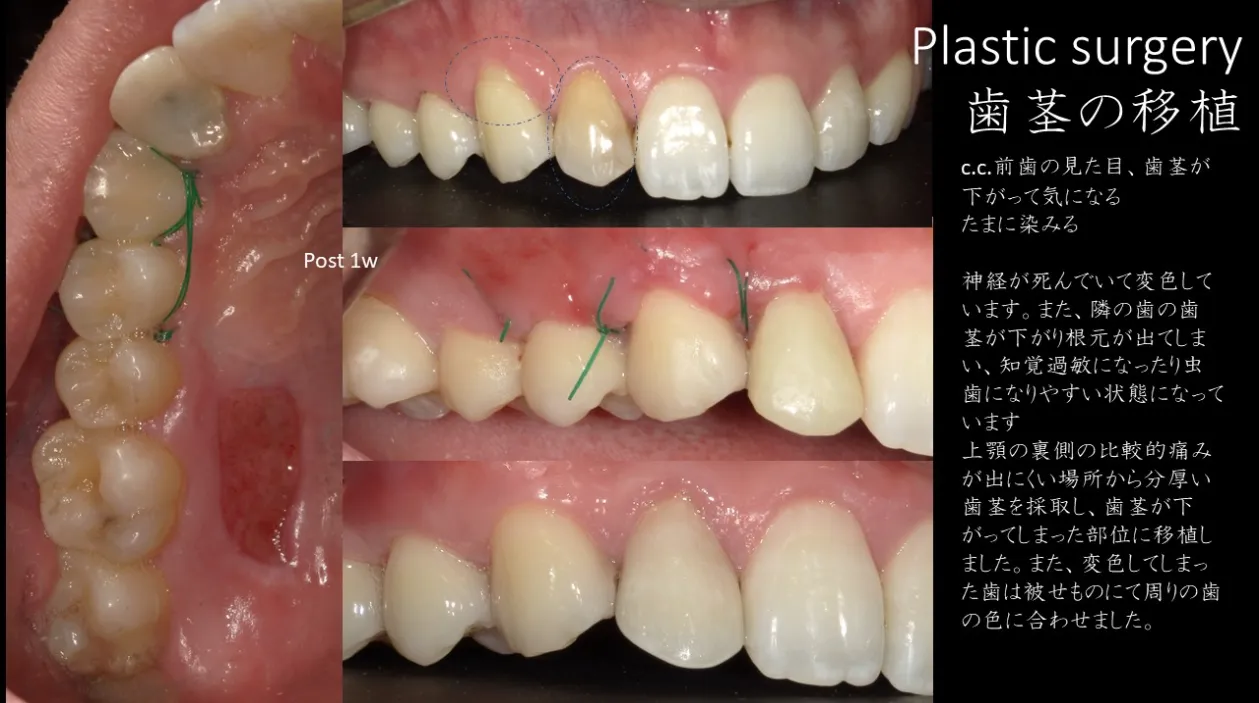
Cosmetic dentistry case 1: Gum graft
Chief complaint: Appearance of the front teeth; bothered by receding gums; sometimes sensitive
The nerve is dead and the tooth has discolored. The gum on the neighboring tooth has also receded, exposing the root, which makes it prone to hypersensitivity and decay.
We took thick gum tissue from an area on the palate that tends to cause less pain and grafted it onto the area where the gum had receded. The discolored tooth was given a crown to match the color of the surrounding teeth.
Cost
X-ray examination: ¥1,300
Periodontal tissue examination: ¥600
Connective tissue graft: ¥100,000
Total: ¥101,900
Treatment period and number of visits
2 months (5 visits)
Risks and side effects
There are risks of post-operative swelling, infection, renewed gum recession, and crown damage.
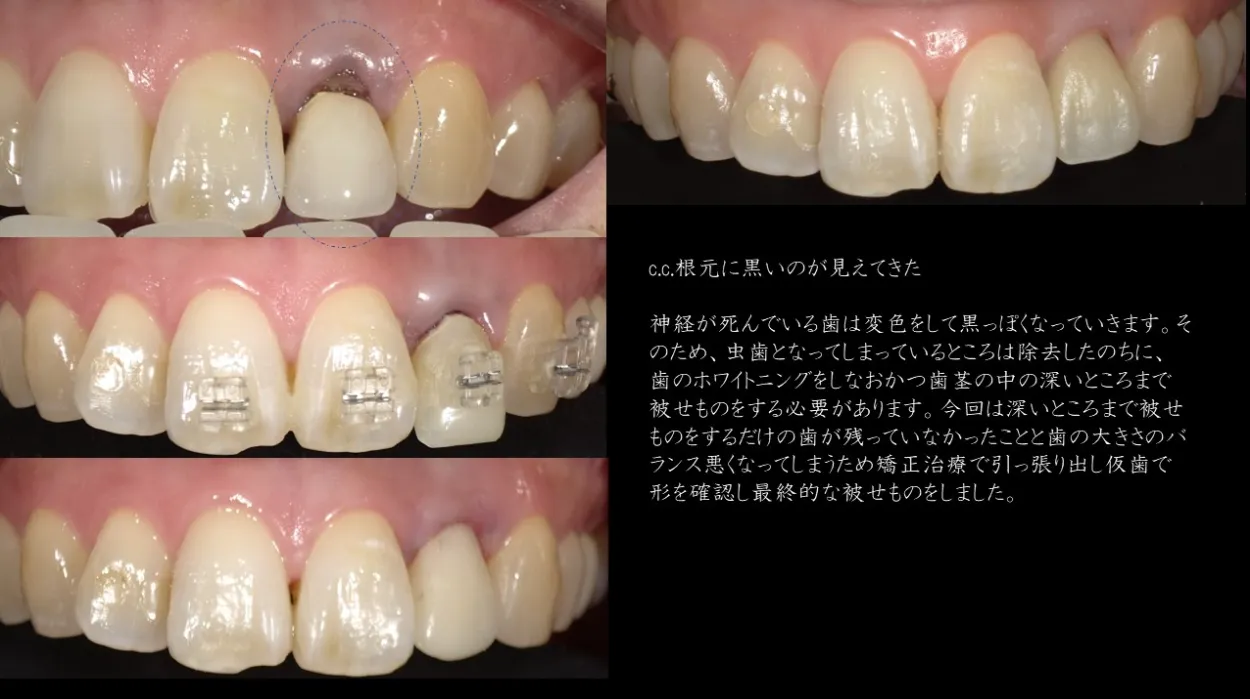
Cosmetic dentistry case 2
Chief complaint: Something dark has started to show at the base of the tooth
A tooth with a dead nerve discolors and darkens. So after the decayed part is removed, the tooth needs to be whitened and a crown placed that extends deep below the gum. In this case, not enough tooth was left to place a crown that deep, and the teeth would have looked uneven in size, so we used orthodontic treatment to pull the tooth further out, checked its shape with a temporary crown, and then placed the final crown.
Cost
Decay removal and root canal treatment: ¥30,000
Whitening: ¥50,000
Orthodontic treatment (partial orthodontics): ¥825,000
Temporary crown: ¥10,000
Ceramic crown: ¥110,000
Total: ¥1,025,000
Treatment period and number of visits
Decay removal and root canal treatment: 4 visits
Whitening: 3 sessions (depending on the condition of the teeth)
Orthodontic treatment: 2.5 years
Temporary crown adjustment: 3 visits
Ceramic crown placement: 3 visits (impression, try-in, final placement)
Risks and side effects
Decay removal and root canal treatment
・The tooth may become more brittle after nerve treatment.
・You may feel discomfort or pain after treatment.
Whitening
・You may experience temporary sensitivity.
・Regular maintenance is needed to keep the effect.
Orthodontic treatment
・Moving the teeth can cause mild pain or discomfort.
・The gums may recede.
Ceramic crown
・It can break (especially under strong force).
・You may feel discomfort in your bite.